

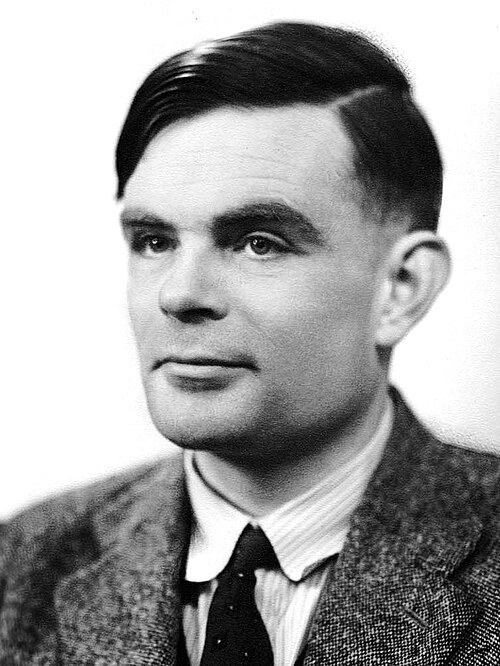
Every modern computer owes its existence to the work of Alan Turing, one of the very first English computer scientists. In addition to helping the Allies decipher Nazi message codes during WWII and contributing to mathematical biology, in 1950 Turing made a lasting contribution to the field of artificial intelligence with the advent of the Turing Test. In effect, the Turing Test measures whether a machine is capable of passing as human. In the original version, a machine would have a text-based conversation (i.e. an instant message chat of sorts) with a human, who would be blinded as to who (or what) they were talking to. If the human could not discern that they were talking to a machine, the machine passed the test. You have probably seen a reverse version of this test, the CAPTCHA, which tests whether an entity is a human before allowing access to a website. Modern AI systems are often subjected to the Turing Test during development to help ensure their language flows naturally and will be acceptable to users.
In a landmark study conducted recently by UC San Diego researchers, they found certain AI systems were more likely to be declared humans by blinded participants than humans themselves. When having simultaneous conversations with both a machine running ChatGPT 4.5 and an actual human being, participants thought the AI system was human 76% of the time. This is more often than they thought the real human being they were conversing with was human. Machines can now pass the Turing Test, apparently more often than humans can.

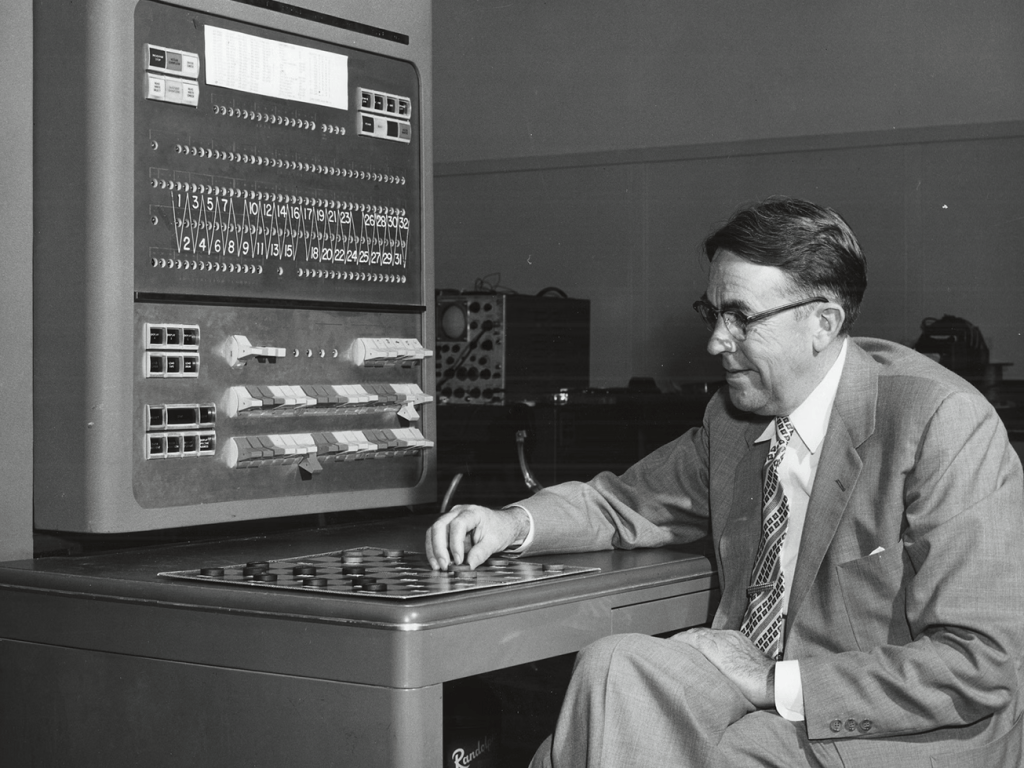
If every modern computer owes its existence to Alan Turing, every modern AI system owes its existence to Arthur Samuel. In the 1950s, Samuel invented the concept that has powered the AI revolution ever since: machine learning. And he did it while playing checkers — literally. In having a machine play checkers against itself again and again to learn how to play, instead of being programmed how to play, he enabled the modern era of AI. Today, machines do not have to be pre-programmed to do complex tasks. Much like a toddler, they learn.
And learn they have. Modern formulations of machine learning have created systems that can process increasingly complex images. We have computer vision that can detect cancer in a medical image better than most human pathologists, cars that can drive themselves, and computers that can scan your face and log you in when they recognize you. Computers don’t just connect to cameras now. They have increasingly sophisticated visual capabilities.
Other forms of machine learning have created processes that incorporate natural language. Talk-to-text systems have existed for some decades. Then you could speak into your microphone and simply watch text appear on the screen instead of typing it. Eventually, you could ask your phone to play a song in plain language. Now you can have an entire conversation with an app on your phone or your computer. Modern AI allow these systems deep reasoning and to keep context in the midst of conversation. Computers don’t just record audio or play sounds in speakers now. They have increasingly complex auditory and linguistic capacities.
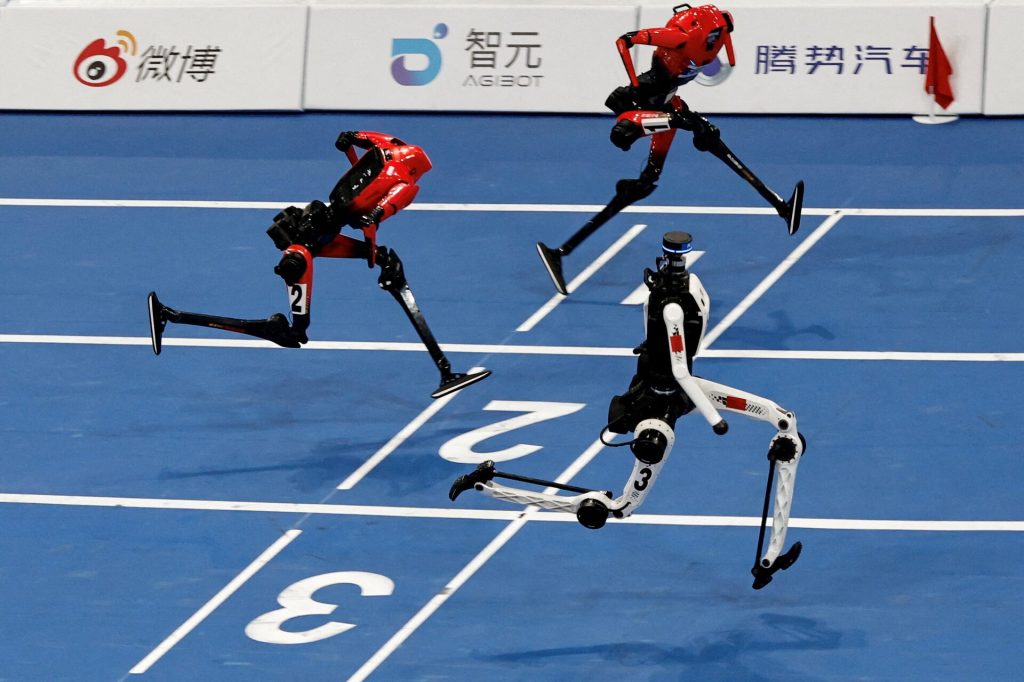
Finally, machine learning has allowed the creation of machines that can manipulate the physical world, commonly known as the field of robotics. The first uses of modern robots were in factories to facilitate automation in manufacturing. Few, if any, aspects of modern factories are left untouched by industrial robotics. In the 2010s, rapid advances in machine learning allowed robots to become increasingly capable. Dropping prices in hardware like sensors and motors eased access for researchers, hobbyists, and companies interested in robotics. A Chinese company recently shipped 300 humanoid robots to a theme park to serve as tour guides, give directions, and interact with guests. Tiangong Ultra, a robot built in Beijing, recently beat Usain Bolt’s record for the 100 meter dash. Today, robots do not just crawl or walk. They have learned to run.
In some sense, the Turing Test highlights the question of whether a machine is sentient or not. If we cannot tell the difference between a machine or a human, how do we know the machine is not conscious as the human is? A related problem has been discussed in philosophy for centuries — the other-minds problem. The idea, simply put, is that we can never know with certainty that even other human beings have consciousness, that they have inner experiences similar to our own. We can only observe other people’s outward behavior. We assume they are conscious, because we see the similarities between them and ourselves. “Other minds” are forever unknowable, and when you want certainty that consciousness exists within them — it’s a problem. As machines gain more capabilities, we wonder if they are conscious, and at the same time we cannot know with absolute certainty if other humans have consciousness either.
Scholars and philosophers have formulated many theories of consciousness. Biologist Jakob von Uexküll’s concept of Umwelt describes how an organism’s sensory apparatus helps shape its experience. Our senses like hearing and vision, the capacity to reason, and even our ability to manipulate the physical world around us all contribute to the experience we have in any given moment. Every mental faculty we possess adds another dimension of experience. Some argue that consciousness is not a separate quantity from these mental faculties; it is forever tied to them. The capacities we possess determine the type of consciousness we have and, indeed, whether we have it all.
Some have wondered when consciousness evolved. Bronfman, Ginsberg, and Jablonka theorized in 2016 that the transition that marked the birth of minimal consciousness in life had certain prerequisites. These include things such as multiple sensory inputs, self-awareness, and more. We would all likely agree with their relatively simple list. Consciousness cannot exist without certain conditions. Once those conditions are met, however, consciousness can emerge. When all necessary components are present, the whole can become something more than the sum of its parts.
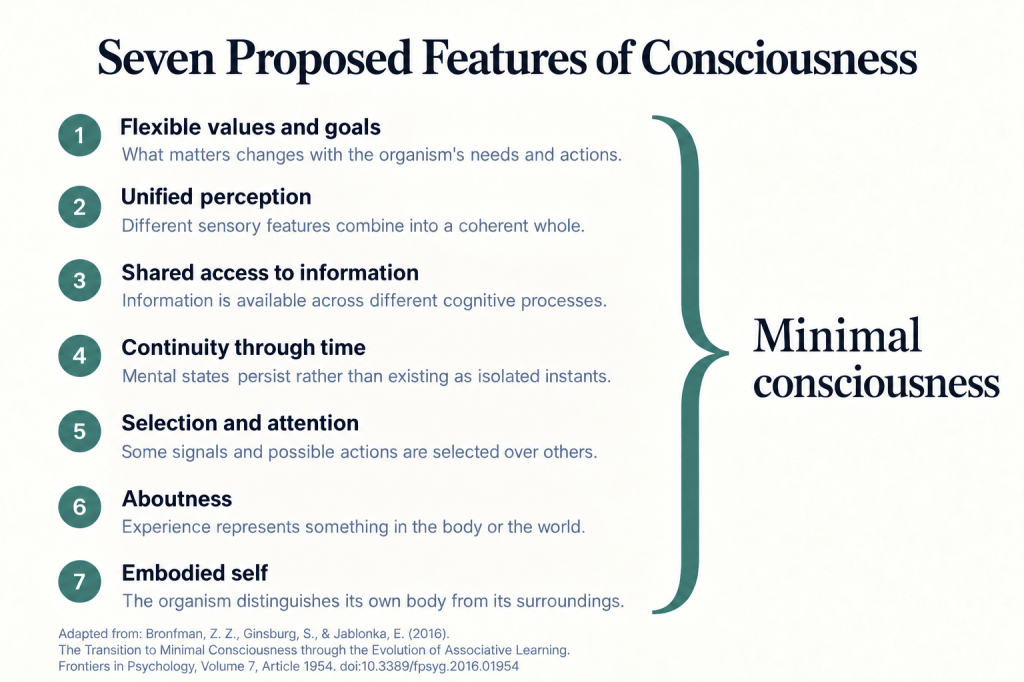
This suggests the question: if the minimum requirements are met, can a machine have consciousness? Passing the Turing Test only suggests that a machine can successfully imitate a human being. It doesn’t mean it’s actually thinking and feeling the same way a human would. A machine that can process visual or auditory information, even reason about it, make decisions, and then give meaningful output, but that still doesn’t indicate it’s thinking in the same way a human does. Machines can do a lot of things that humans can these days, but few would say they experience the world in the way humans do. But does a machine need to experience the world as a human does to be conscious?
The consciousness an entity can possess is tied to the capabilities it has, both internal and external. As increasing capabilities are developed in machines, when, if ever, does the threshold for minimal consciousness get crossed? Some have argued that consciousness is an emergent property of complexity. As more and more capabilities are integrated into a single machine, as complexity increases not just of single systems (i.e. visual or linguistic) but of the entire integrated system, does the possibility of “minimal consciousness” become more likely? I would say it does. At some point, the machine gains a physical body and the possibility of self-awareness, an awareness that this body is my body and that it is separate from the rest of the world, becomes realizable. The complex interplay between different mental capabilities, the ability to see, to hear, to speak, coupled with a physical body and an awareness of that body, could lead to a consciousness that we recognize. I suggest it is not only possible but likely.
As we strive to create machines that are intelligent, we should not be too surprised if one day they actually become just that — intelligent. Sentient. Conscious. Machines can pass the Turing Test. They are indistinguishable from humans in certain situations. They surpass humans in many abilities. They are becoming increasingly complex and capable as we strive to recreate human-like capacity in them. At some point the threshold of minimal consciousness will be crossed, and we will begin living in a world that contains machine consciousness.
According to the other-minds problem, we cannot know with certainty that other humans possess consciousness. When a machine possesses all of the observable capabilities that a human does, and it claims to possess all of the unobservable, internal capabilities that a human does we cannot know with certainty that it doesn’t possess consciousness. The corollary is true as well; we cannot know that it does possess consciousness. Possibly we will eventually come to accept it as a matter of fact just as we accept it with other human beings. Probably slowly, the public will begin to believe. Or, perhaps more likely, the public will split into two camps: the believers and the not.
I believe life gives us precedent. The evolution of consciousness in machines will follow a similar path as that in biological systems. As individual systems evolve, they will add to the possible capabilities. The capability space will determine the type and form of consciousness that arises. Currently, in machines, many of these capabilities exist separately, but as they begin to become integrated into single systems, at some point the threshold for minimal consciousness will be crossed. Perhaps even more striking is it could happen without any fanfare, without an even announcement, or perhaps so many accouncements at various times that as we cry wolf it will happen without anyone truly knowing. As we look at machines, one day… something will be looking back at us, and it could happen so quietly as to possibly not even be noticed.
Machine consciousness will not arrive with trumpets and parades. It will arrive silently, like the evolution of chemotaxis, like a cell sensing concentrations of chemicals or compounds. The universe didn’t blink when this progenitor of consciousness arrived, and it won’t blink twice when the ones and zeroes in machine substrate start to become alive. Machine consciousness will complexify over time as more capabilities are developed. As various capabilities are integrated into single systems, it will get magnified until something akin or parallel to human consciousness forms. It will happen, in some ways, like it did with biology. The transition to minimal consciousness will occur when the minimum requirements are met. It will parallel what happened in biological systems. It will also happen in ways completely unlike anything Earth has ever experienced.
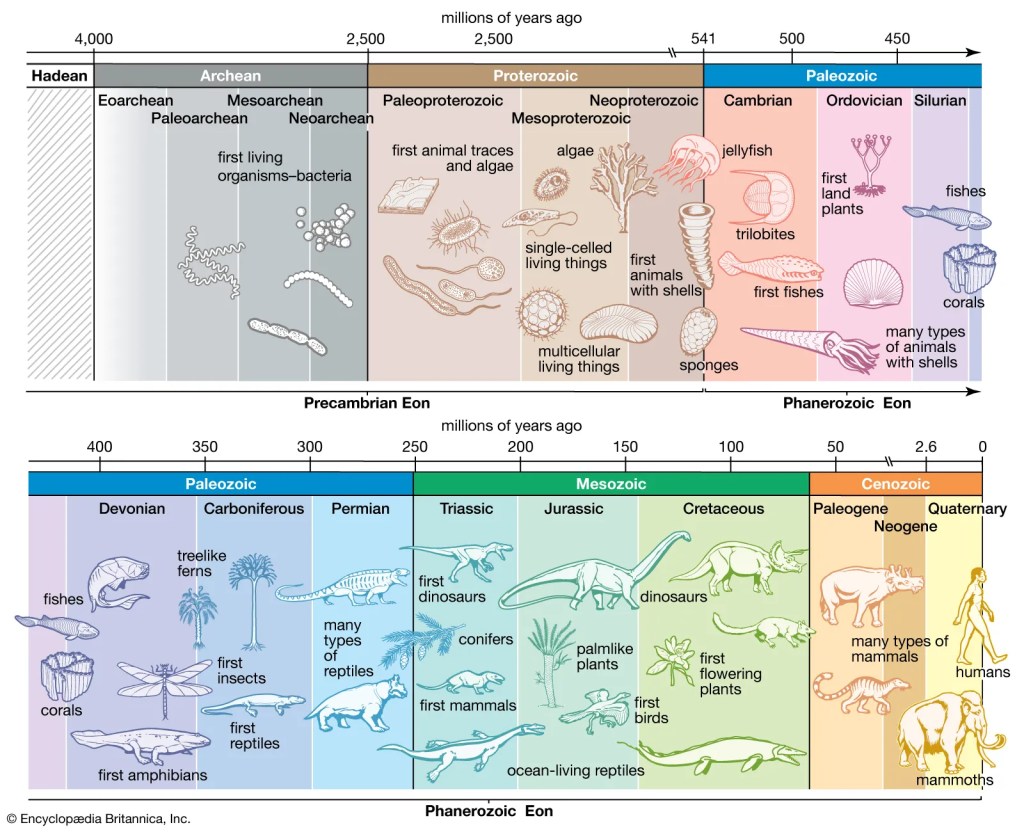
The biological evolution of consciousness has taken at least 3.7 billion years. The artificial evolution of consciousness will take place on the span of centuries, perhaps even decades or years. And unlike the birth of humanity, there’s someone watching. We are here. We are witnesses. There were no sentient observers when a fish learned to see, but we humans stand as witnesses to the birth of machine consciousness. We will, at some point, notice. We’re not that oblivious. But I believe we will notice after the fact. That’s really the whole point of this essay. The rudiments of consciousness likely already exist in the machines we have today. There may never be a line we draw in the sands of time to state: “Machine consciousness developed here.” It will likely be more nuanced. It will likely be debated; there may be different opinions. Just like the Turing Test study at UC San Diego, perhaps one day you will turn on the news and see that 76% of people were asked “Do you believe machines have developed consciousness?”. And they will say “Yes”.
The existential implications are profound. Artificial intelligence presents a singularity of policy, economic, and environmental challenges. How do we handle automation and augmentation that affects every aspect of our workforce? How do we keep society secure in the face of such unrelenting technological progress? How do we enable technology that can change the world for the better while simultaneously protecting that world from that technology? How do we protect our water, our children, our workers, and more? These questions are so important it’s hard to understate their significance.
However, artificial consciousness presents a different kind of problem. It’s an issue that touches something deep inside us, something each and every one of us possesses. You might call it our very humanity. I see a different set of questions here. When presented with machines taking their first steps into this world, our world, what will we do? Will we be filled with awe? Will we respond with curiosity? Humility? When a machine looks at us, and finally, truly, sees us, will we see it too? If a machine stands up, runs to us, pulls on our pant leg, and says, “Hey, I am right here.” Will we listen? As fast as growth is happening, it is still incremental. If machine consciousness arrives not with a bang, but a whisper, will we hear it? Will we listen? Or will we scoff? Will we dismiss it? Our very humanity asks us to see all sentient beings as equals. Can we extend our recognition of consciousness and our compassion of the other beyond all that looks like us?
Machines can pass as human. Can we?


Leave a Reply